First compiled and transcribed in 144 A.D., its foundational canon dates back to 34 A.D.
This archive does not begin with an oral tradition or a collection of folklore, but with a specific, direct event: the Revelation to St. Paul on the road to Damascus in 34 A.D. Unlike other gospels that were compiled years later by anonymous authors from 'fuzzy memory' or second-hand accounts, the Evangelion is the written record of the words seared into Paul’s mind by a direct intercession of Christ. This project serves to restore that primary, unmediated message - The Gospel of the Lord - which Paul referred to as "my gospel" on multiple occasions and preached throughout the Roman Empire to establish the first Christian churches.
The transcription of the year 144 A.D. represents the primary evidentiary find in the field of
textual criticism, establishing the definitive framework of The Very First Bible. This archive
is not a historical curiosity; it is a strategic preservation of the unalloyed Christian record.
While the later 382 A.D. canonization (Latin Vulgate) was an exercise in ecclesiastical inflation - cobbling
together four gospels and 'stapling' an entire alien religion to the front to harmonize
conflicting narratives—the 144 A.D. archive remains structurally pure. It consists of a single
Gospel (the Evangelion) and ten Epistles (the Apostolikon), predating the Judeo-Roman
intervention that would fundamentally alter the faith’s textual DNA.
The forensic preservation of this archive was directed by Saint Marcion of Sinope, founder of the Marcionite Christian Church. A
shipowner and the son of the Bishop of Pontus, Saint Marcion functioned as a real-life 'Indiana Jones,' utilizing his merchant fleet to retrace the Apostle Paul’s missionary
journeys. His methodology was rigorously forensic: he visited the original churches across
the Roman Empire to recover the earliest Greek manuscripts.
His maritime background
directly influenced the physical evolution of the Bible; to prevent bulky scrolls from 'flying
around' on a windy merchant ship, he transitioned the records into the codex format. This
move from scrolls to books allowed for a tidy, professional collation of the Pauline
revelation, providing the world with its first bound Christian scripture.
Click image to view documents in situ at the Vatican Library
A critical component of the archive involves the "Argumentum" - the original
prologues discovered and verified through the Vatican Library’s document digitization
campaign. These prologues provide the forensic "who, why, and what" that was
systematically removed from later versions of the Bible. They identify specific geographical
audiences - such as the Greeks in Galatia - and the situational pressures, like subversion by
false apostles, that necessitated Paul’s correspondence.
These 'Argumentum' documents
serve as the essential forensic context for the archive. This physical preservation allows for
a deep analysis of why the central figure of this faith maintained a strategic authorial silence.
Core Distinctives of the 144 A.D. Evangelion
Temporal Precision: The gospel is 'time-stamped' to begin in the 15th year of Tiberius
Caesar (29 A.D.), with Pontius Pilate as governor. The day of the arrival is marked by a total solar eclipse and seismic event in the Capernaum region as described by the historian, Phlegon of Tralles
The Capernaum Descent:
Jesus is described as descending directly into Capernaum, a
city in Galilee, immediately establishing his ministry and revealing for the first time - God Our Father - who was previously unknown to the world. Pre-Nicene Christian belief holds that Jesus descended to earth in fully human form and left the same way He arrived - by ascending and descending from heaven.
Immediate Authority: The text emphasizes that his "word was in authority," bypassing
any requirement for rabbinic validation or recognition by their Yahweh deity.
Rejection of the Law: The Gospel portrays a figure who commands unclean spirits and
heals on the Sabbath, openly challenging the 'bondage' of the Torah.

Slide to visualize the accumulation of texts from 144 A.D. to the Present Day.
The Evangelion and original Ten Epistles. No Tanakh (Old Testament).
The 144 A.D. archive is the 'Unalloyed Rock of Truth' for the Pre-Nicene Christian faith. From a forensic perspective, any Bible compiled after 144 A.D. - and especially after the 325 A.D. Judeo-Roman intervention - is merely a book subjected to erasures, creative interpolations, deletions, and damnatio memoriae.
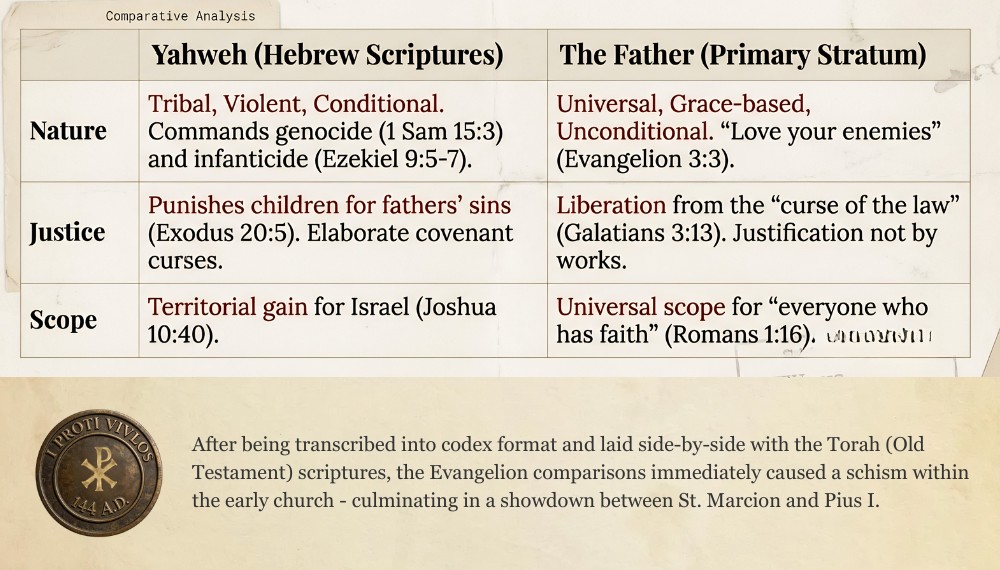
The strategic integration of the Tanakh (Old Testament) was not a development, but a historical subversion that led to the 'bad fruit' of modern denominational confusion. For the modern professional audience, the "So What?" is clear: the absolute distinction between God Our Father and the Yahweh deity is the cornerstone of theological integrity. Without this distinction, the faith remains tethered to a barbaric law that the Apostle Paul and early Christians fought to exclude.
Critical Takeaways
Textual Primacy: The 144 A.D. archive is the only unedited transcription of the Pauline revelation, predating the Catholic 'stapling' of the Torah books, which now comprise 75% of the modern bible.
Non-Judaized Revelation: The Gospel of the Lord was intended strictly for the Nations, providing a foundation entirely separate from the Judaized anonymous gospels promoted by Peter, John and James: "James and Cephas and John, those reputed to be pillars,
the right hands of fellowship they gave to me and Barnabas; that we should go unto the nations, but they unto the circumcision." - Galatians 2:7.
Forensic Archiving: The work of Saint Marcion and the recovery of the 'Argumentum' prologues provide the context necessary to defeat early attempts at de-contextualization and marginalization of subversive activities.
The Pre-Nicene Keleuthos Foundation continues its mission of global dissemination and forensic preservation of this archive. Through digital formats, including free eBooks and Audiobooks, the foundation ensures this unedited record remains accessible to all who seek solid theological ground.